
This dim mak section explains the best pressure points to use today in our modern society. You’ll learn about how some ancient points have been replaced with other points that are more effective for you to use today.
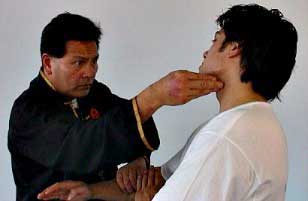
One of the best dim mak pressure points is Stomach 9, point application shown by Grandmaster Pier Tsui-Po
In your study of pressure points, it is important for you to know that in the past few decades, some ancient pressure points have been replaced with others that are more effective for our modern society. So if you’ve come across some books that just give a list of ancient points, be very careful.
Centuries ago, senior masters of Chinese martial arts developed the art and science of deadly pressure point fighting. Since then, various graduates of the Shaolin martial arts temple have categorised one set of 108 dim mak pressure points. These were made up of two groups: 72 points that caused unconsciousness or temporary paralysis and 36 that could kill.
There were also other sets of points that have not been disclosed openly to the public; they have been reserved for trusted and long time disciples of some kung fu Masters, for example, the Never Walk Again Point. We each these best pressure points in our classes at the Golden Lion.
So do these ancient pressure points share the same adverse effect when struck on today’s human body?
Dim mak pressure point fighting and healing has not and is not, a stagnated art. Much has changed since these ancient masters categorised the points: dim mak study has evolved to meet the changes.
With the advent of modern medicine and technology, and a greater understanding of the human body and how it functions, the effects of trauma to some points can be treated in hospitals and by doctors. Where once a blow or strike would guarantee death, or permanent and serious injury and illness, now some of these injuries can be alleviated with modern medicine and treatment.
In addition, people are stronger these days, our immune systems have adapted to deal with a wider range of diseases, illnesses and injuries, and each successive generation can become stronger mentally, physically and emotionally.
While this is great news for the human race, it means that the effectiveness of a pressure point as an injury point may have shifted— not the location of the point itself, just its adverse effects on the mental and physical aspects of the body.
Pressure point Kidney 1 Yong Quan is a perfect example
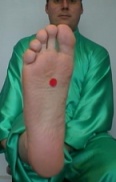
Some ancient points used for self defence are no longer useful as they used to be. Pressure point Kidney 1 Yong Quan located on the sole of the feet (see image) is a perfect example. This ancient death point is now more useful as a healing point. I offer a full and detailed discussion about this point in my book Two Dragons of Dim Mak.
A few adjustments to the list of best pressure points have been made over the last few decades. It pays to know them.
So… an ancient death point may now be more effective in causing injury or it may have a greater use as a healing point rather than a target for self defence.
By the way, similar situation applies to the locations of pressure points.
In all our books and DVDs, we teach a special method that we’ve formulated to help you find the location of pressure points QUICKLY and EASILY.
The current training regime of practitioners is also very different than it was when the ancient masters discovered the usefulness of pressure point fighting. Martial arts is now studied and practised less as a holistic life course, and more as a recreational activity and for self defence.
Once, students trained six or more hours a day. Now training is limited to maybe a few times a week, or less. This affects the way we are able to use and implement the strategies of dim mak.
Although the categorisation of pressure points, according to the effects they have on the body, remains unchanged, the evolution of the art and the human race has meant that adjustments in terms of re-categorising based on their effectiveness and use in various situations have changed. Hence the reason why the books and DVDs we bring to you on the theory and practice of the best pressure points must reflect today’s environment. Repeating the ancient indications would make the art of pressure point fighting ineffective.
This does not diminish the art in anyway, in fact evolving theory and teaching ensures that pressure point defence retains its effectiveness. Without change modern practitioners would need to duplicate the circumstances and training of the Shaolin for pressure points to be effective, and eventually the art would die out.
Keeping up with the changes in circumstance and situation, ensures that dim mak remains an effective art of self-defence and healing, now and in the future.
If you’d like to have copies of our dim mak training manual, books and DVDs for the best pressure points to use, please click here for more information.